
Best Faceless YouTube Niches for 24/7 Live Streams
Seven faceless niches that work as one always-on live stream, what content each needs, who must own it, and the YouTube rules that can stop monetization.
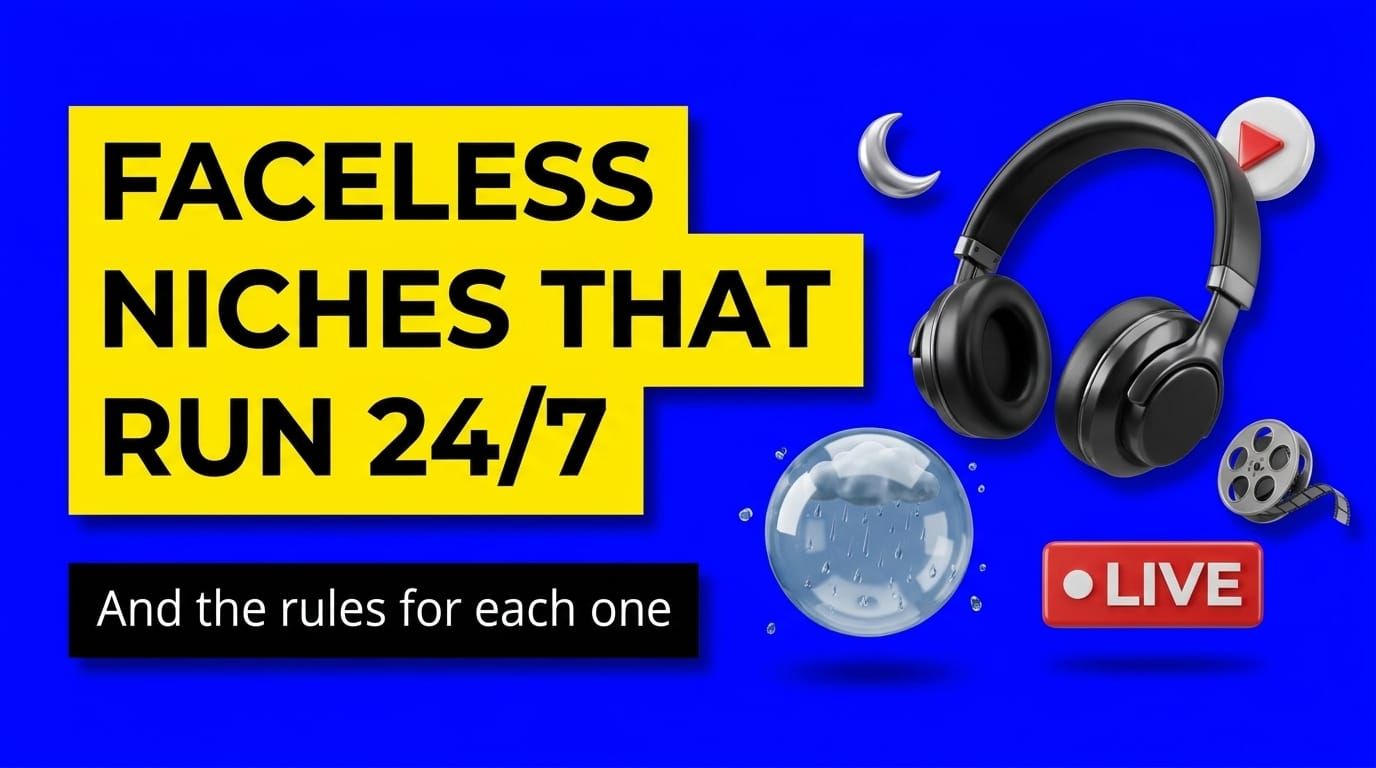
The best faceless YouTube niches for a 24/7 live stream are the ones people leave on in the background. Our picks: lofi and jazz radio, rain and sleep sounds, study-with-me, nature footage, narrated stories, kids' cartoons and old episodes of a show you own. They work live because viewers come for a mood or a channel, not for one video. Each niche asks a different rights question, and kids' content and old episodes carry the most risk.
For each niche, we cover what content you need, who must own it, and which YouTube rule is most likely to cause trouble. Each one ends with a 24/7 live stream template or a guide, so you can start right away. YouTube rules are current as of October 27, 2026.
The top faceless YouTube niches at a glance
| Niche | Why it works 24/7 | Content you need | Biggest risk |
|---|---|---|---|
| Lofi and jazz radio | Background listening for study and work | Music you own or license for live streaming | Reused content (songs by other artists), Content ID |
| Rain and sleep sounds | People play it all night | Your own recordings or a licensed sound pack | Repetitive content |
| Study-with-me and focus | Viewers keep it open for hours | Recordings of your own sessions | Low; repetition if the clip is short |
| Nature footage | Calm, slow, no story to follow | Footage you filmed or licensed | Reused content if it is stock used as is |
| Narrated stories | Long listening sessions, often at night | Stories you wrote | Readings of other people's text |
| Kids' cartoons | Families want something on at any hour | Animation you own or license | Made-for-kids rules, quality rules |
| Old episodes | Works like a TV channel | Your own archive, licensed shows, public domain | Reused content, licence scope |
How we picked these niches
A niche made this list only if it passes three tests:
- It runs with nobody there. No reactions, no news, nothing that needs a host at 3 a.m.
- It can repeat without going stale. A loop of sleep sounds still works next month. A loop of "this week's AI tools" does not.
- You can own or license the content. If you cannot say who owns every file in the playlist, the niche is not ready for 24/7.
For a wider list of faceless ideas built around uploads, see our faceless YouTube channel ideas.
1. Lofi and jazz radio
Why it works live. A music radio is the classic 24/7 format. Listeners put it on while they study or work, and the live chat gives regulars a place to talk.
Content and rights. You need a long playlist and a still or animated background. The music can come from three places:
- Tracks you made, or tracks made for you under a written licence that covers live streaming.
- YouTube's Audio Library. YouTube says its tracks are copyright-safe and will not be claimed through Content ID. Creative Commons tracks need a credit in the description. YouTube also says it is not responsible for "royalty-free" music from other libraries (YouTube Help). Audio Library tracks are still songs by other artists, so read the monetization risk below.
- Public domain music, with care. In the US, songs published in 1930, such as "Georgia on My Mind", entered the public domain on January 1, 2026. Only the composition is free. Each recording has its own copyright, so use a recording you made, licensed, or confirmed is in the public domain (Duke Center for the Study of the Public Domain).
Risks. YouTube scans every live stream for third-party content. A match can put a placeholder on your stream, then interrupt or end it. Licensed music can still be interrupted unless the owner adds your channel to their Content ID allowlist (YouTube Help).
The second risk is monetization: YouTube's monetization policy lists "collections of songs from different artists (even if you have their permission)" as reused content that cannot earn. A radio built only from other artists' tracks fits that description. The safest radio is one where most of the music is yours or made for you.
Start with. Four radio templates built on an audio playlist: lofi with chat overlay, minimal lofi, soul and synthwave. Setup guides: 24/7 lofi radio and 24/7 music channel on YouTube. For music rights in more depth, read how to play music in a live stream without copyright problems.
2. Rain, nature and sleep sounds
Why it works live. Sleep and rain streams are made to play all night. A live stream does not end, so nobody has to restart a video at 4 a.m.
Content and rights. Record the sounds yourself, or buy a sound pack whose licence names live streaming or broadcasting. If the licence does not say, ask the seller before you go live. Pair the audio with your own footage or artwork.
Risks. Copyright risk is low when you recorded the sound. The bigger risk is YouTube's inauthentic content policy.
Its examples of content that cannot earn, on the same policy page, include content with "minimal variation across videos" and image slideshows with no narrative or value. YouTube does not say how it treats one continuous ambient stream, so plan for variety: several soundscapes, scenes that change, a schedule with themes.
Start with. The relaxing spa template (an audio playlist with calm visuals), and our guide to a 24/7 meditation channel on YouTube.
3. Study-with-me and focus streams
Why it works live. Viewers open a study stream and keep it on while they work. Seeing a "Live" badge and a chat of other people studying is part of the appeal.
Content and rights. Film your own study or work sessions: hands, desk, notebook, screen. No face needed. Add a timer and licensed background music. You own what you filmed, as long as the music and anything shown on screen are cleared too.
Risks. Low on copyright, as long as the music is cleared. A single short session on repeat gets dull fast, so record many sessions and rotate them. To set expectations in the chat, note in the description that the sessions are recorded.
Start with. The work radio template (a focus music playlist with a minimal background) for a music-only stream. For your own session videos, use the video playlist template.
4. Nature footage and slow TV
Why it works live. Forests, oceans, fireplaces and train rides need no story. People use them as a window on the wall.
Content and rights. This niche works best with footage you filmed yourself. A true real-time wildlife camera needs hardware on site, which is outside this post. Here we mean recorded footage played as a long loop or playlist.
Risks. Stock footage is tempting, but YouTube lists "content downloaded or copied from another online source without any substantive modifications" as reused content that cannot earn. Stock clips played as they are fit that description, even with a valid licence.
Start with. The video playlist template, and our tutorial on looping a video on YouTube Live 24/7.
5. Narrated stories
Why it works live. Horror, mystery and bedtime stories hold listeners for hours, often late at night. One long story playlist can cover a whole night.
Content and rights. Write the stories yourself and narrate them, or hire a narrator. Add artwork or slow background video.
Risks. YouTube lists "content that exclusively features readings of other materials you did not originally create" as reused content that cannot earn. Reading forum posts or another author's stories aloud fits that. Write your own.
Start with. The horror stories template (an audio narration playlist with an animated background).
6. Kids' cartoons
Why it works live. Families look for something safe to put on at any hour, and a cartoon channel that is always live fills that need.
Content and rights. Animation you made, or episodes you licensed with live streaming rights. Older cartoons can be in the public domain: in the US, the first Betty Boop cartoons and nine Mickey Mouse cartoons from 1930 entered it on January 1, 2026. Only the original 1930 versions are free. Later versions, and new creative material added in a restoration, can still be protected, and the rules differ outside the US (Duke Center for the Study of the Public Domain).
Risks. This niche has the strictest rules.
- You must set the audience. YouTube requires every creator to mark content as made for kids or not, for the whole channel or for each video and live stream. This follows its agreement with the US FTC and the COPPA law (YouTube Help).
- Made for kids switches features off. No live chat, no comments, no Super Chat, no notification bell and no personalized ads. YouTube says this "may result in a decrease in revenue" (YouTube Help). Without live chat, chat-based polls and games cannot run either.
- Quality rules. Under YouTube's quality principles for kids content, a channel with a strong focus on low-quality made-for-kids content may be suspended from the Partner Program. One listed sign is videos that are hard to follow, "often the result of mass production" (YouTube Help).
- Public domain cartoons are uploaded by many channels. YouTube lists "content uploaded many times by other creators" as reused content that cannot earn.
Start with. The video playlist template, and our guide to starting a 24/7 YouTube channel for kids. The made-for-kids setting is in the YouTube stream settings in LiveReacting.
7. Old episodes and your back catalogue
Why it works live. A playlist of episodes plays like a TV channel. Viewers drop in at any time and stay for the next episode.
Content and rights. Three sources, from safest to riskiest:
- Your own archive. Past videos and past live streams from your channel. Use the ones where you still hold the rights to everything in them, music included. See how to repurpose your whole YouTube channel into a 24/7 live stream.
- Licensed shows. The licence must cover live streaming on YouTube. The rights holder should also add your channel to their Content ID allowlist, or YouTube can interrupt the stream (YouTube Help). If you owe the rights holder per play, LiveReacting can give you a record of what played and when, on request.
- Public domain films and shows. Check the year, the country, and whether the copy you have is a restoration with new material.
Risks. YouTube's reused content policy "applies even if you have permission from the original creator", and it is separate from copyright (YouTube Help). A licence gives you the rights it names. It does not stop automated claims, and it does not show YouTube that the channel adds something of its own. Your own archive is the cleanest case.
Start with. The video playlist template, and 24/7 YouTube channels as linear TV.
Niches we left out, and the "highest RPM" lists
Some faceless niche lists rank niches by RPM. YouTube defines RPM as your revenue per 1,000 views after YouTube's share, from ads, memberships, Premium, Super Chat and Super Stickers (YouTube Help). We do not print RPM figures here. They change by country, season and audience, and we found no current, dated public source we trust.
These niches suit uploads better than one long live stream:
- Finance, tech and news. The advice dates fast, and a loop keeps playing last month's facts. YouTube also bars channels from earning when an AI persona presents itself as a human expert giving financial, health or legal advice (YouTube Help).
- Compilations, clips and reactions. Compilations and clips with little of your own added, and reactions without real commentary, are classic reused content.
- Gaming replays. Monetization depends on the rights each game publisher grants. YouTube also says videos that simply show someone playing a game for long periods may not be accepted for monetization (YouTube Help). See our 24/7 gaming channel guide.
- Fitness classes. The 24/7 page has a fitness template, but most classes show the instructor, so the niche is not faceless.
YouTube's rules on mass-produced and repetitive content
YouTube's channel monetization policies apply to "Shorts, long-form videos, and live streaming". The points that matter for a 24/7 channel:
- Inauthentic content. On July 15, 2025, YouTube renamed its "repetitious content" policy to "inauthentic content" to make clear it covers repetitive or mass-produced content. Examples that cannot earn include content with minimal variation, templated storylines, and AI content made from generic templates.
- Reused content. Content taken from YouTube or elsewhere without significant original commentary, changes or value. Permission does not fix it.
- The whole channel is reviewed. Reviewers look at the channel's main theme, most viewed and newest videos, the biggest share of watch time, titles, thumbnails and the About section. If they cannot tell that you made the content, monetization can be removed from the entire channel.
YouTube enforces this. Early in 2026, a Kapwing report found that at least 18 channels publishing AI slop had been deleted or had their videos hidden (Tubefilter). For what this means for always-on channels, read YouTube's AI content crackdown and 24/7 streamers.
Just to be clear, a 24/7 stream does not change these rules. For YouTube, it is one more video on your channel. So pick a niche where you make the content yourself or clearly add something to it. And don't plan your budget around monetization until YouTube has reviewed the channel.
How to launch a 24/7 stream in one of these niches
The basic flow in LiveReacting:
- Upload your files, or import them from Google Drive, Dropbox or your YouTube channel.
- Build the playlist: video files, or an audio playlist over a background with a visualizer.
- Connect your YouTube channel and set the audience (made for kids or not).
- Click Go Live.
- Switch your computer off. The stream runs on our servers.
Two things matter once the stream runs for weeks. First, reliability. Streams run with more than one cloud provider, in several data centers in Europe and the US. If the server behind your stream stops answering, the stream starts again on another server by itself.
Video files sit in two storage services with automatic switch-over, the stream reconnects if the platform link drops, and broken files are skipped, not played.
Second, control: the API and the MCP server, on every paid plan, let your code or an AI agent, such as ChatGPT with our ChatGPT plugin, change the playlist while the stream is live.
If you plan a network of niche channels, read how to run 24/7 live streams on several faceless YouTube channels. For the rest of the stack, from scripts to thumbnails, see our list of YouTube automation tools.
In short, the best faceless niche for you is the one where you own the content. Once you pick it, open one of our 24/7 templates and you are ready to go live.
FAQ
Can a 24/7 live stream be monetized on YouTube?
Yes, if the channel is in the YouTube Partner Program and the stream follows its policies. YouTube's monetization rules apply to live streams the same as to uploads, and reviewers check the channel as a whole. Nobody can promise approval or income in advance.
Is lofi music free to use on a 24/7 stream?
Only if the licence says so. Music you made, music made for you under a written licence, and tracks from YouTube's Audio Library are the safe options for copyright. Even with permission, a channel that only plays other artists' songs can fail YouTube's reused content check.
Do I have to mark a cartoon stream as made for kids?
Yes, if children are the audience. YouTube requires every creator to set the audience, for the whole channel or for each video and live stream. A made-for-kids stream has no live chat, no comments and no personalized ads.
Which faceless niche is easiest to run 24/7?
Rain, sleep and ambient sound streams, or study-with-me streams of your own recordings. You own the content, the copyright risk is low, and the content does not date. The main risk is that the stream feels repetitive, so give it real variety.
Transform Your Live Streams with LiveReacting
Join 10,000+ streamers who are boosting engagement and viewership by adding pre-recorded videos, games, polls, and countdowns to their streams.
Try LiveReacting for free today and take your streams to the next level!