
How to Live Stream a Pre-Recorded Video on YouTube (3 Ways)
Two ways to send a recorded video to YouTube as a real live stream, OBS or the cloud, plus YouTube's Premiere. With a comparison table and a weekly repeat setup.
There are two ways to send a pre-recorded video to YouTube as a real live stream. OBS plays the file from your own computer. It is free, but the computer and its connection must stay on until the end. A cloud streaming tool plays the file from its own servers. Your computer can be off, and the stream can start on a schedule and repeat every week.
YouTube's Premiere is a third option, for YouTube only. It plays an uploaded video once with a live chat, but it is not a live stream.
The table below compares all three. YouTube's rules and the plan details in this guide are current as of October 27, 2026.
Key takeaways:
- OBS is free, but the stream stops if your computer sleeps, crashes or loses its connection.
- A cloud tool such as LiveReacting or Upstream streams from its servers, so your computer can be off.
- A Premiere is free and needs no software, but it runs once, on YouTube only, at 1080p at most.
- YouTube can take up to 24 hours to switch on live streaming the first time. Request it a day early.
- To repeat a stream every week, use a cloud tool with recurring scheduling. A Premiere cannot repeat.
Which method should you use?
| Method | Cost | Computer reliance | Scheduling | Best for |
|---|---|---|---|---|
| OBS + stream key | Free | Your computer and your connection carry the whole stream | You start OBS yourself at the right time | Free, hands-on, one-off streams |
| Cloud tool (LiveReacting, Upstream) | LiveReacting: Free plan to test (3 streams a month, 30 minutes each, 720p, no scheduling), paid plans from $19.99/mo ($16/mo billed yearly). Upstream: free plan with 24 hours a month. | None. The stream runs on the tool's servers | Set a date and time, or repeat it daily or weekly (LiveReacting: Medium plan and up) | Scheduled, repeated or long streams |
| YouTube Premiere | Free | None after the upload | One date and time, runs once | One new video, one time, YouTube only |
A Premiere is not a live stream. It plays a video you already uploaded, and in YouTube's words, afterwards it "stays on your channel as a regular upload." OBS and a cloud tool send a real live stream. A cloud tool can also loop the video, repeat the stream and send it to other platforms at the same time.
First, turn on live streaming
Methods 1 and 2 send a real live stream to YouTube, so the channel has to be cleared for it first. YouTube's own live streaming requirements are short: "To live stream, you need to have no live streaming restrictions in the past 90 days and you need to verify your channel."
| Requirement | Detail |
|---|---|
| Channel verification | Required |
| Live streaming restrictions | None in the past 90 days |
| Age | At least 16. YouTube: "You must be at least 16 years old to live stream." |
| First activation | Up to 24 hours, the first time only |
| Streaming from a phone | At least 50 subscribers |
Request it in YouTube Studio: click Create, then Go live. YouTube's encoder guide says: "Enabling a live stream for the first time may take up to 24 hours. Once enabled, your stream can go live instantly." Request it the day before you need it. Our guide to enabling YouTube live streaming shows the screens.
Method 1: OBS with a media source (free, computer on)
- In YouTube Studio, click Create, then Go live, then open the Stream tab and create the stream.
- Copy the stream key. Our guide covers how to find your YouTube stream key.
- In OBS, add a Media Source and point it at your video file.
- Paste the key into Settings, then Stream, and click Start Streaming.
- To end, click Stop Streaming. YouTube says: "All streams under 12 hours will be automatically archived."
It works, and it is free. The cost is the machine. Your computer runs for the whole broadcast, and your home connection carries every frame. A connection failure can interrupt the stream, and so can sleep mode, an update or a crash. You also have to be at the computer when the stream starts, so for anything scheduled this is the weakest method. If you want the ingest details, see what rtmp://a.rtmp.youtube.com/live2 actually is.
Method 2: Stream it from the cloud (computer off), step by step
This is the method where your computer can be off. LiveReacting encodes and broadcasts the video from its own servers. The basic steps are the same ones Upstream and Gyre document: add the video, connect the channel, set the time, go live.
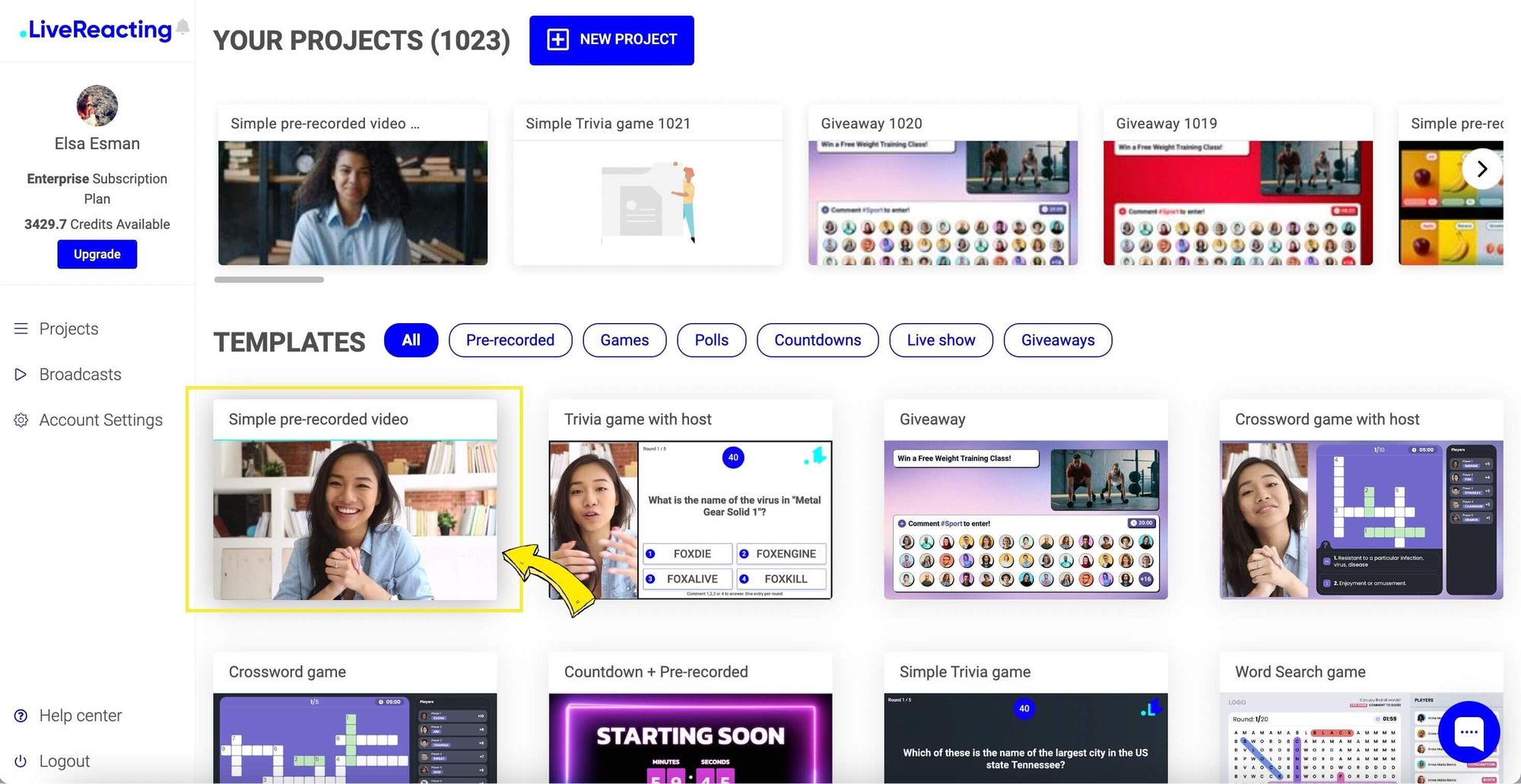
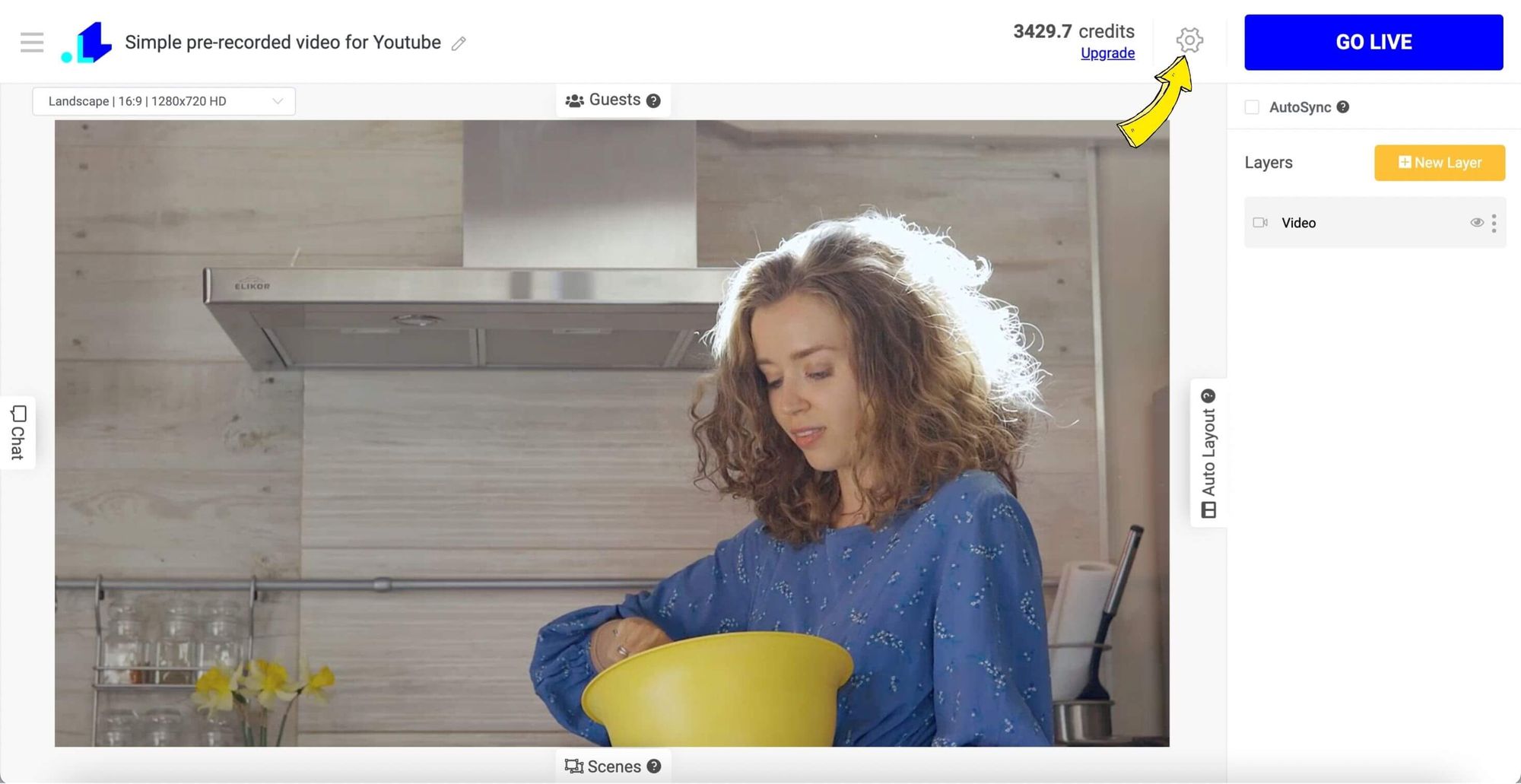
- Create the project. Log in and pick the Simple pre-recorded video template.
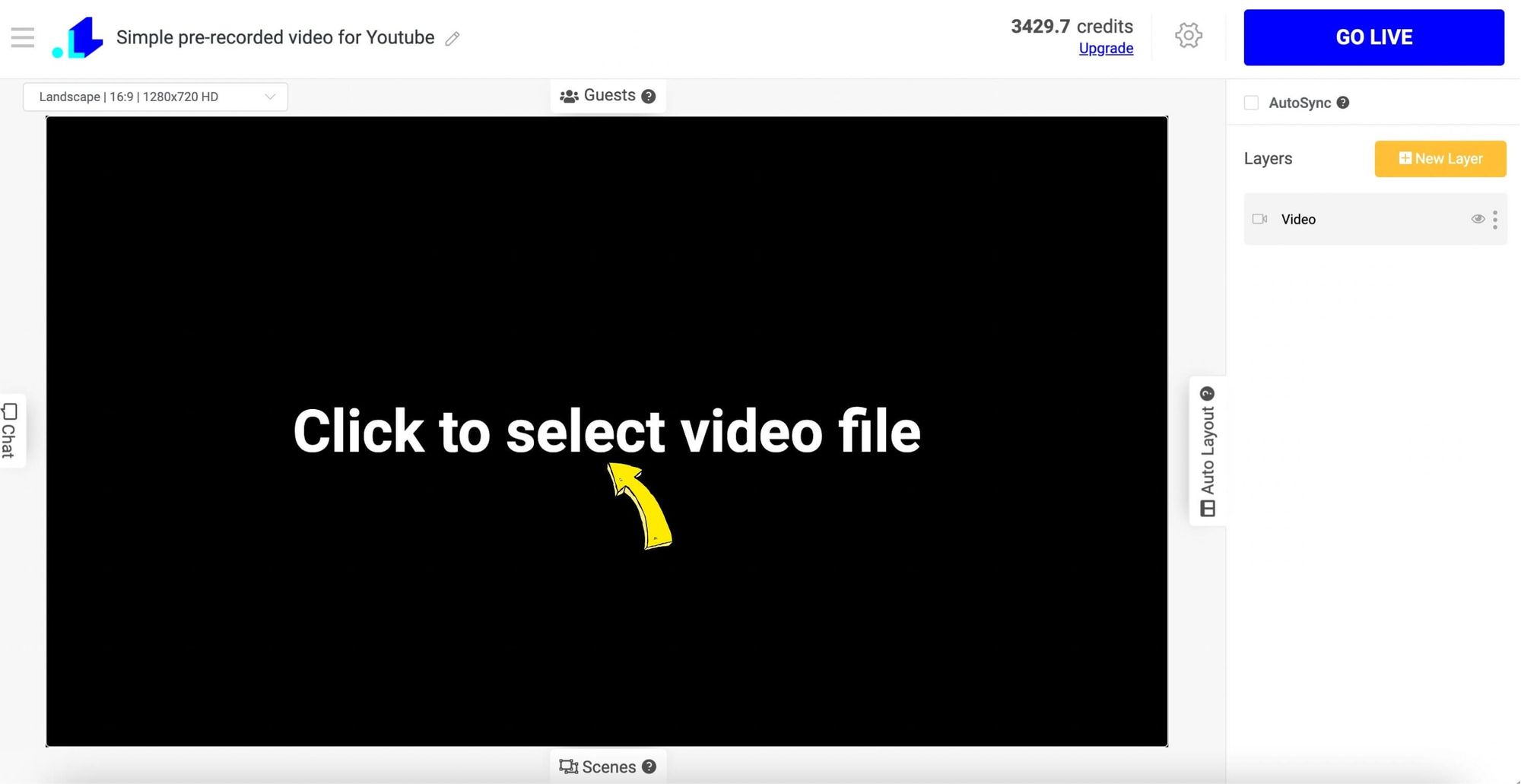
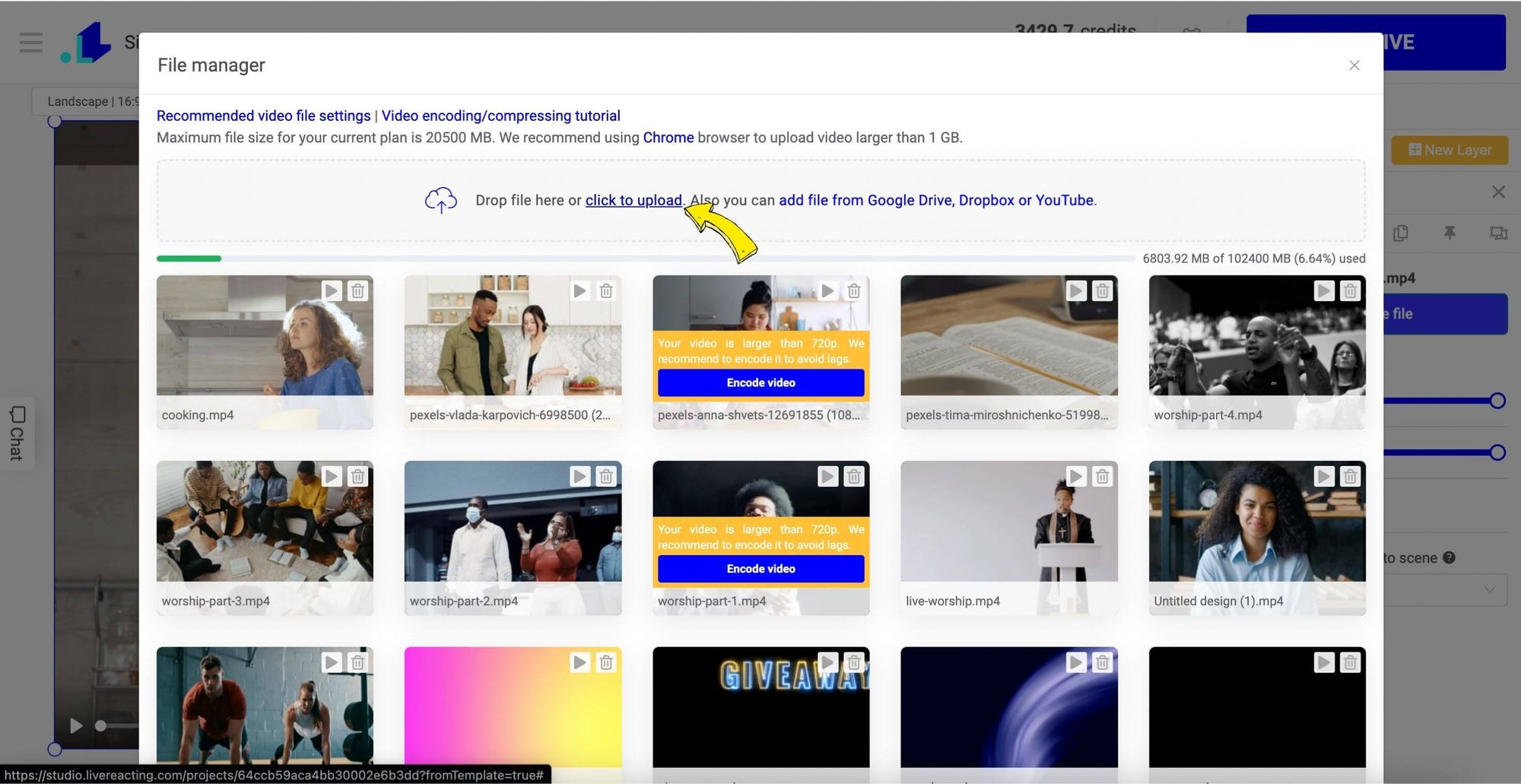
- Add your video. Click Click to select video file, upload the file in the file manager, then tap it to add it to the project. On a paid plan you can also import it from Google Drive, Dropbox or YouTube.
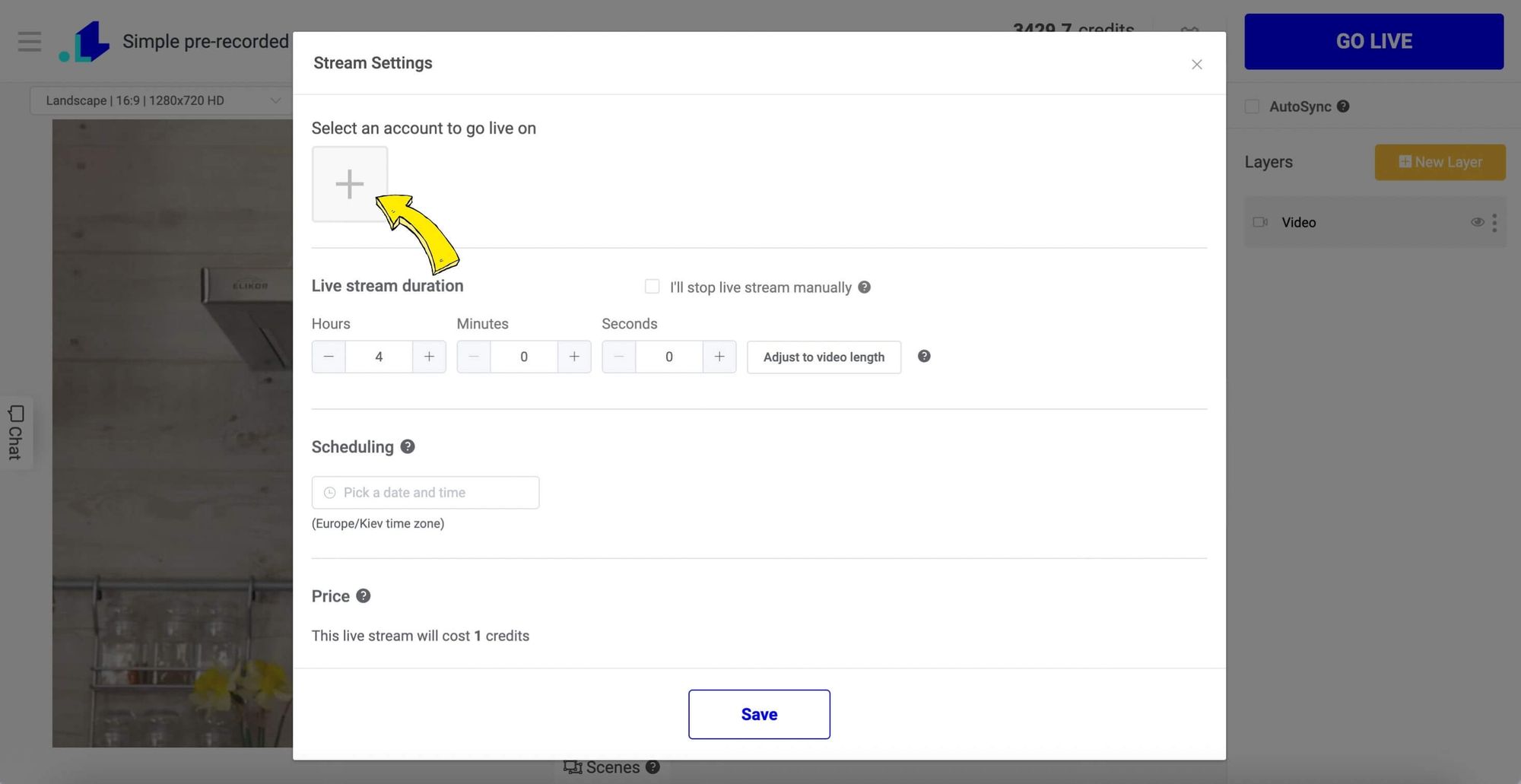
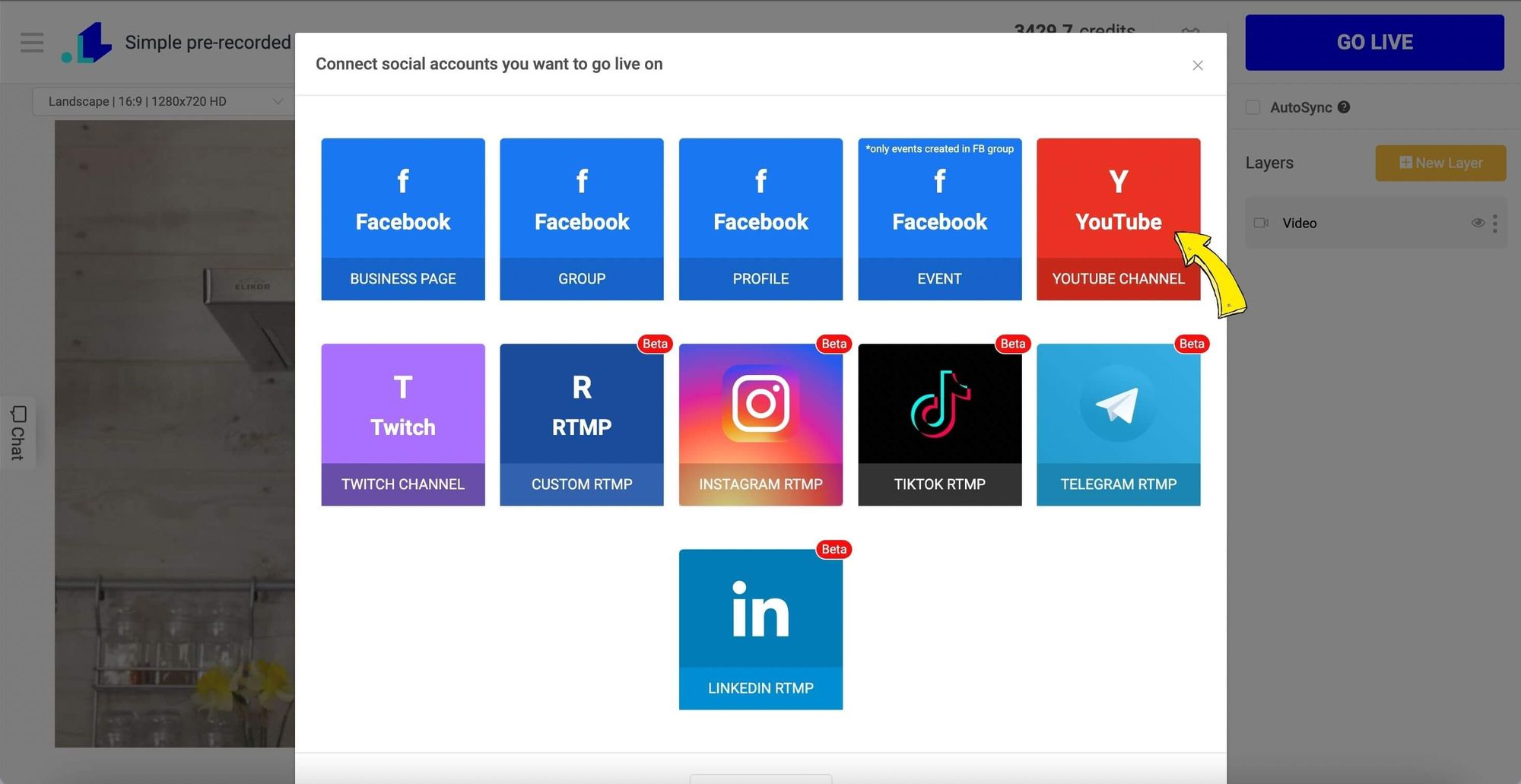
- Connect your YouTube channel. Open Settings with the gear icon, click the plus icon, and sign in to the channel you want to go live on. You can connect more than one account here, two different YouTube channels included, and broadcast to all of them at once.
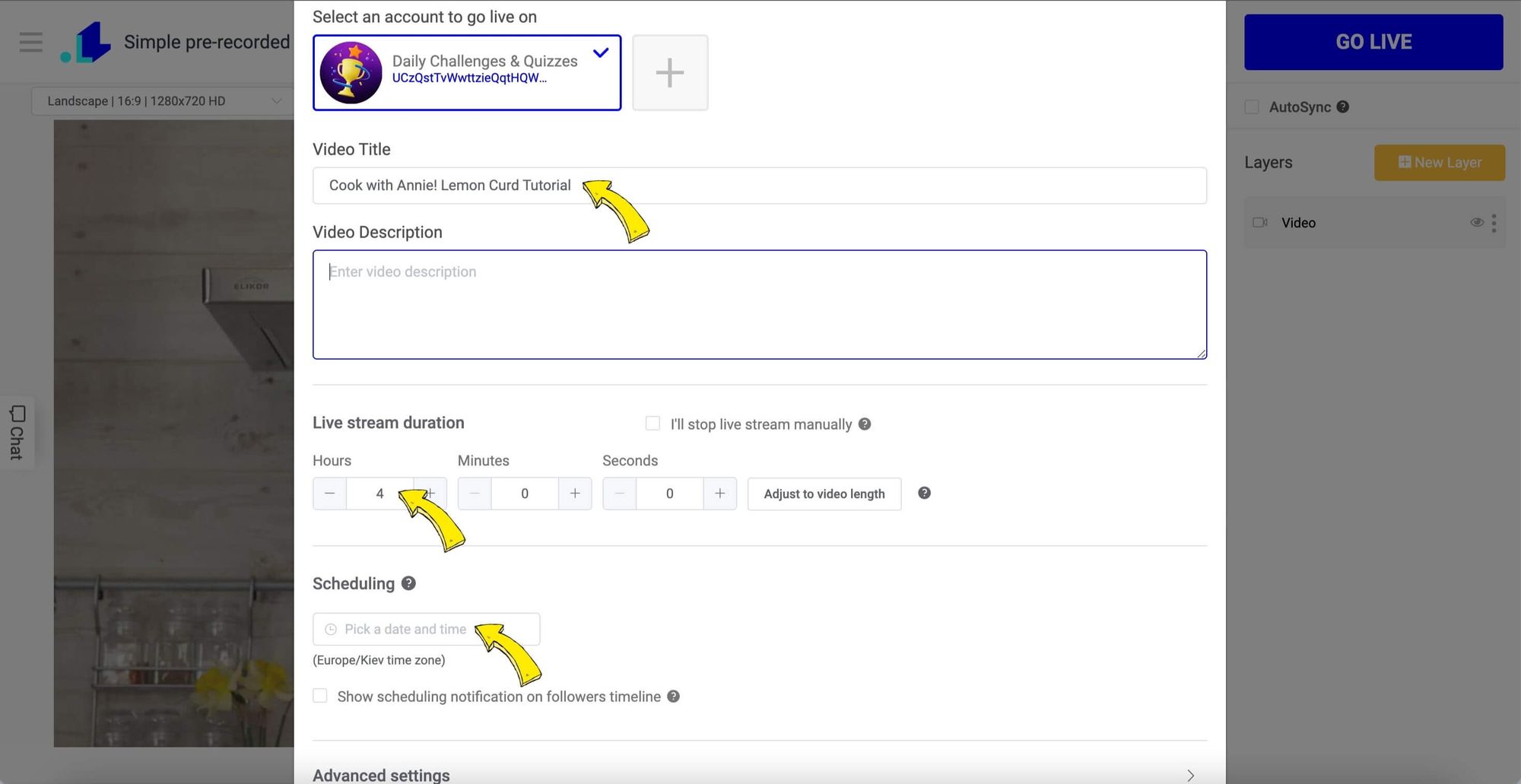
- Fill in the stream details: title, description and stream duration. Adjust to video length matches the duration to the file. To run it later, pick a date and time up to four weeks ahead. Tick the live announcement option as well, and YouTube builds the watch page straight away, so you have a link to share before the stream starts.
- Check the pin, then go live. The pin under the preview sets the starting point, so leave it at 00:00 to play from the beginning. Press Go Live, and the stream appears on your YouTube channel.
Once it starts, close the browser. The broadcast runs on LiveReacting's servers. Scheduling needs a paid plan. On the free plan the only button is Go Live.
If something fails. If the server running your stream stops answering, the stream starts again on another server by itself. The servers run with more than one cloud provider, in several data centers in Europe and the US. Your video files are kept in two storage services, with an automatic switch-over between them. If YouTube drops the connection, LiveReacting reconnects. A broken file in a playlist is skipped, not played.
Run it from code or an AI agent. Every paid plan includes the API and an MCP server. Your own code, or an AI agent such as Claude, Codex, Cursor or ChatGPT (through our ChatGPT plugin), can create the stream, add the video, schedule it and change it while it is live. Upstream offers an API and an MCP server too.
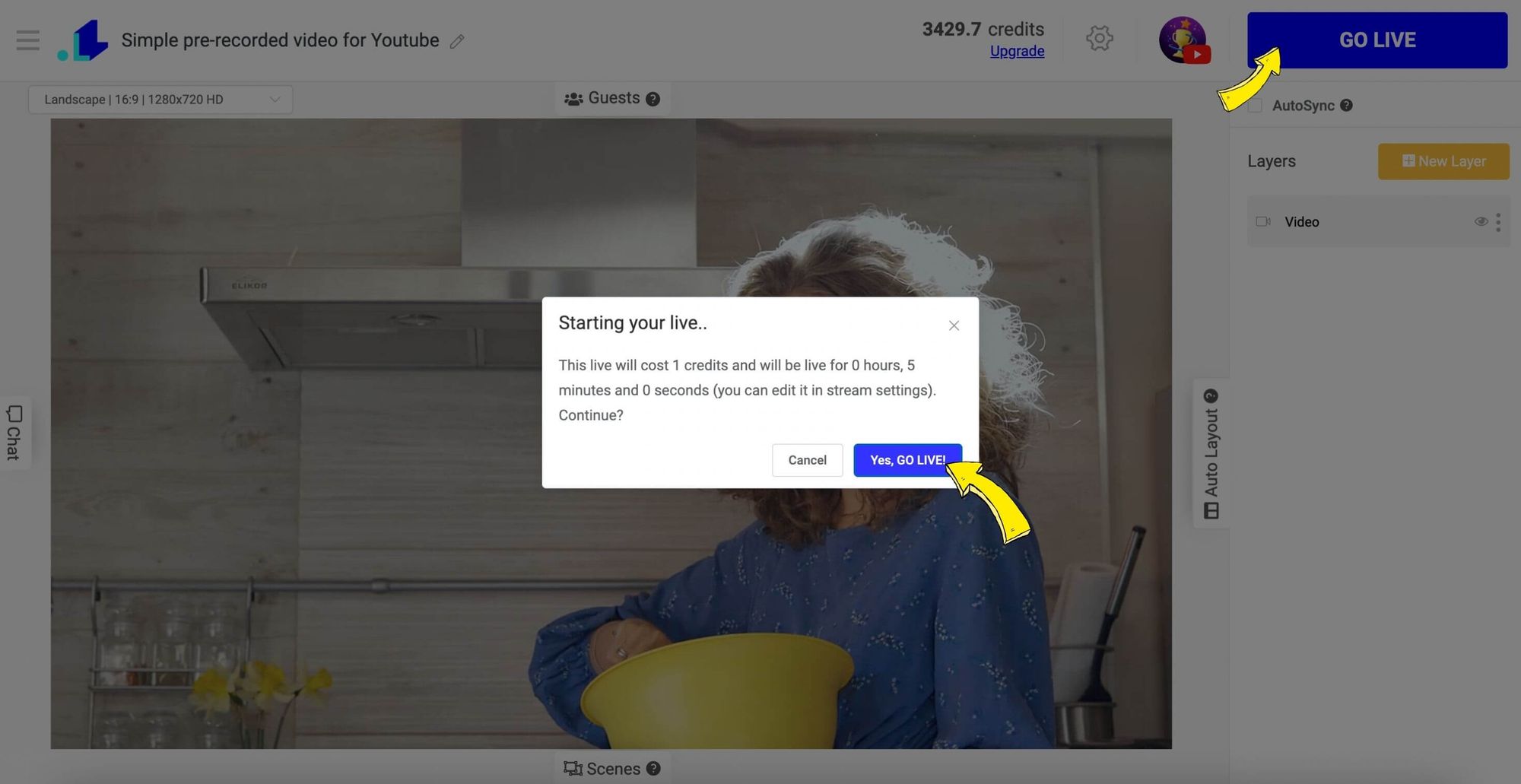
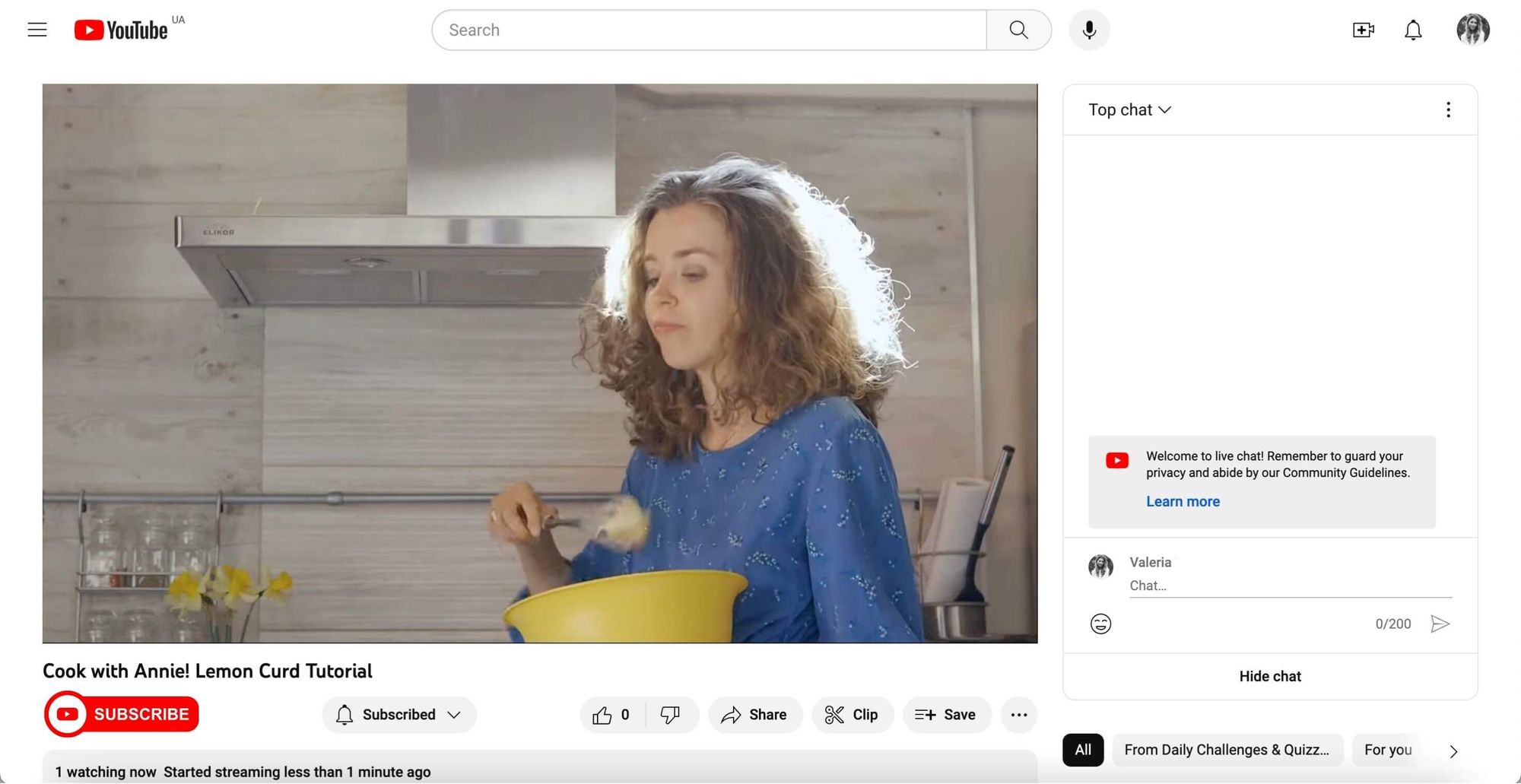
Video walkthrough
The same five steps, on screen.
Method 3: YouTube Premiere (free, but not a live stream)
A Premiere plays a video you have already uploaded, at a set time, with a live chat next to it. YouTube describes it as letting "you and your viewers watch and experience a new video together in real time." It is not a live stream. After it ends, the video "stays on your channel as a regular upload."
- In YouTube Studio, click Create, then Upload videos, and fill in the video details.
- To start straight away, click Save or publish, then Public, then Set as instant Premiere. It premieres when the video finishes processing.
- To run it later, click Schedule, enter a date and time, and check Set as Premiere.
- Click Done or Schedule, then share the watch page. Viewers can set a reminder and chat before it starts, and chat replay stays available afterwards.
Three limits come straight off YouTube's Premieres documentation. "Shorts aren't supported for Premieres." Nothing above 1080p works either, and neither does "360/vr180". And "if your account has a Community Guidelines strike, your Premiere won't publish during the penalty period."
A Premiere also runs once. It cannot loop, repeat on a schedule or reach a second platform. That is enough for a launch or a one-off event. If you need any of it to repeat, use method 2.
Make it repeat every week
A recorded class, a sermon or a weekly show can air again on the same day each week. A Premiere runs once, and with OBS you start each stream yourself. A cloud tool with recurring scheduling starts every run for you.
In LiveReacting this is Advanced Scheduling, on the Medium plan ($39.99/mo, or $33/mo billed yearly) and up, and on the 24/7 plan. Upstream also repeats schedules daily or weekly.
- Set up the project as in method 2, and set the stream duration.
- In the scheduling options, choose Repeat and set it to run every 7 days. Or choose Multi-date and add each date.
- Tick the live announcement option if you want a YouTube watch page for each run. LiveReacting creates a separate announcement for every run.
- Schedule it. Your computer can be off for every run.
What to know before you set it:
- One schedule holds up to 50 runs within 30 days. There is no endless weekly repeat in one setting, so set the next batch when it runs out.
- Each run starts the video from the beginning. With a playlist, turn on Keep stream progress, and each run starts with the video the last one stopped in.
- After you schedule, you cannot edit the dates, the duration, the title or the description. Cancel, make the change, and schedule again.
- Keep each run under 12 hours, so YouTube archives it automatically.
What your video file should look like
| Setting | What to use |
|---|---|
| Container | .mp4, .m4v, .mov, .flv, .webm, .ogv, .3gp, .wmv, .avi, .mkv |
| Video codec | H.264 |
| Audio codec | AAC |
| 720p bitrate | 4 Mbps at 30fps, 6 Mbps at 60fps |
| 1080p bitrate | 8 Mbps at 30fps, 12 Mbps at 60fps |
| 4K bitrate | 30 Mbps at 30fps, 35 Mbps at 60fps |
If your file misses these numbers, upload it anyway. LiveReacting re-encodes it for free, so you do not need a converter first.
YouTube settings worth fixing before you press go
Most of these sit under Advanced settings in the stream panel. Set each one before the stream starts.
| Setting | Why it matters |
|---|---|
| Privacy | Public, Unlisted or Private. Decide before the stream, not during it. |
| Thumbnail | Shows on the watch page while you are live and on the replay afterwards. |
| Disable DVR | Stops viewers rewinding, so everyone is watching the same moment. |
| Made for Kids | The COPPA setting. YouTube turns live chat off on streams set as made for kids, so do not tick it by accident. |
| Category and tags | Feeds YouTube's discovery. Tags take up to 500 characters. |
| Playlists | Adds the stream to a playlist while it is still running. |
| Audio quality | 128k is the safe setting for YouTube. |
| Video bitrate | Leave it on Auto unless you have a reason not to. |
Plan the length too. YouTube archives a live stream automatically if it runs for less than 12 hours. On longer streams, YouTube's archive page says: "If your stream exceeds 12 hours, it may not be captured at all."
What you can still control while it runs
Handing the file to a server does not lock you out of it. Three controls stay live.
- Pause. The video holds on the current frame and the broadcast holds with it. Press Sync with Live to start it moving again.
- Rewind. Drag the pin back to any point, press Sync with Live, and that section plays again.
- Scenes. Cutting to another scene pauses the video. It picks up from the same frame when you cut back.
The third one is what makes a pre-recorded stream feel live. You can cut to a countdown, a poll or a webcam and never lose your place in the file.
Loop it, or leave it running
The same upload can run past a single broadcast.
- Loop one file for an always-on channel. See how to loop a video on YouTube Live 24/7.
- Queue several files in order with a video playlist.
- Turn a back catalogue into a permanent channel with a 24/7 YouTube live channel, with no OBS and no machine of your own. The 24/7 live streaming plan has no limit on stream length.
Send the same video to more than YouTube
One upload can go to several destinations at the same time. Add each one in the same Settings panel. Comments from every platform you connected by signing in land in one chat feed. A destination added with a stream key sends no comments back.
YouTube, Facebook Pages and profiles, Twitch and Instagram connect by signing in. Kick, LinkedIn and any other platform that takes a stream key connect over RTMP. HLS and SRT output come by request, on a custom plan. There is a full walkthrough of multistreaming without the OBS multi-RTMP plugin.
Add polls, trivia and giveaways
A recorded video feels more live when something on screen answers the chat. Add a live poll, a countdown, a trivia game or a giveaway with the New Layer button, then drag it over the video. Viewers take part by commenting on a platform you connected by signing in.
FAQ
Does YouTube allow streaming pre-recorded videos as live?
Yes. YouTube publishes no rule against streaming your own recording as a live stream, as long as the content follows the Community Guidelines. Monetization is the part to watch. YouTube's channel monetization policies exclude "content that is repetitive or mass-produced". One video streamed as live is fine. A channel of interchangeable loops is a monetization risk. Other platforms set their own rules, and our guide to what each platform allows covers them.
Can viewers tell that a live stream is pre-recorded?
YouTube puts no label on it. The stream sits in the Live tab with an ordinary live chat, and the chat works the same way on a Premiere. The one exception is a stream set as made for kids, where YouTube turns live chat off. Viewers notice what happens in the chat, so answer people while the video plays.
Can I live stream a pre-recorded video on YouTube for free?
Yes, two ways. OBS is free but ties up your computer for the whole stream. In the cloud, Upstream's free plan gives 24 hours of streaming a month, and LiveReacting's Free plan gives three streams a month, 30 minutes each at 720p, with no scheduling. A YouTube Premiere also costs nothing, but it is not a live stream: it plays an uploaded video once, and afterwards the video stays on your channel as a regular upload.
How long can a pre-recorded live stream run on YouTube?
YouTube publishes no maximum length, so the tool sets the ceiling. On LiveReacting one stream runs from 1 hour on the Small plan to 24 hours on Enterprise, and the 24/7 plan has no limit. Plan around YouTube's archive: it saves streams under 12 hours automatically, and says a longer stream "may not be captured at all."
Can I make a pre-recorded live stream repeat every week?
Yes, with a cloud tool. LiveReacting's Advanced Scheduling, on the Medium plan and up and on the 24/7 plan, repeats a stream daily, weekly or on dates you pick, up to 50 runs within 30 days. A Premiere runs once, and with OBS you start each stream yourself.
Start with your next video
Match the method to the job. If one video goes out once on YouTube, a Premiere is enough. If it has to run on a schedule, repeat every week or never stop, upload it once and let the cloud run the stream.
Upload your video and schedule it
Related guides
- How to do a fake live stream (what each platform allows)
- Pre-recorded live streams get 2x more views: real channel data
- How to stream a pre-recorded video to Facebook Live
- Best tools for pre-recorded live streaming
- Turn pre-recorded videos into high-converting live streams
- How to stream a pre-recorded video on Twitch
For a one-page summary, see this guide to a pre-recorded live stream.
Transform Your Live Streams with LiveReacting
Join 10,000+ streamers who are boosting engagement and viewership by adding pre-recorded videos, games, polls, and countdowns to their streams.
Try LiveReacting for free today and take your streams to the next level!