
24/7 YouTube Channels as Linear TV: Monetize Without New Content
24/7 YouTube channels work like linear TV, turning existing content into always-on revenue. Learn how to monetize with curated programming and mid-roll ad breaks.

Large YouTube channels are sitting on thousands of hours of content that was earned once and now collects dust. A 24/7 YouTube channel turns that library into a revenue-generating TV experience that runs around the clock, without producing a single new video.
This is the linear TV model, rebuilt for YouTube. The global FAST (Free Ad-Supported Streaming TV) market was valued at $10.6 billion in 2025 and is projected to reach $12.2 billion in 2026, according to Global Growth Insights. YouTube creators are applying the same playbook.
What Linear TV on YouTube Actually Looks Like
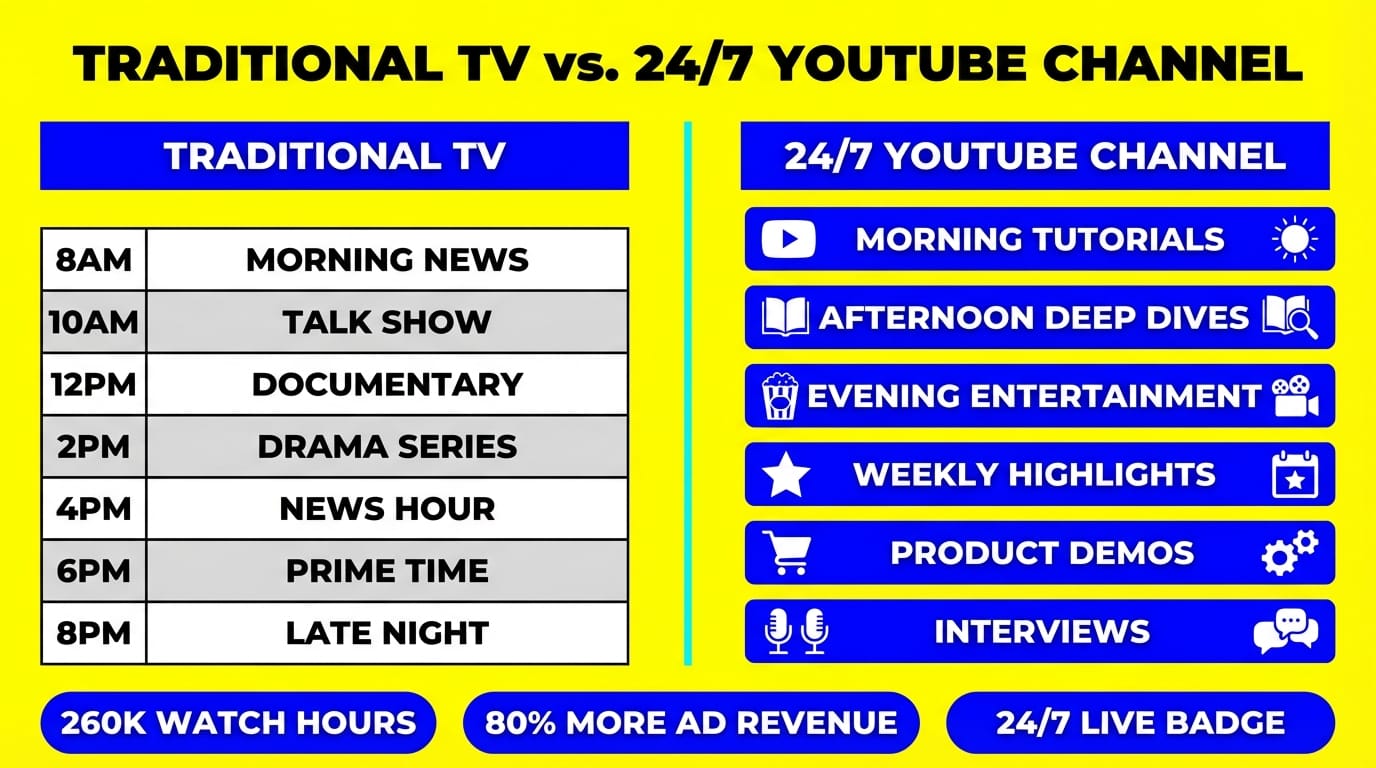
Traditional linear TV broadcasts scheduled programming on a fixed feed. Viewers tune in, watch what's on, and stay because the next segment looks interesting.
A 24/7 YouTube channel works the same way. Take your existing video library, organize it into a curated schedule, and broadcast it as a continuous live stream. Viewers see it as a live broadcast, and YouTube's algorithm treats it like one.
The difference from a basic video loop: programming is curated. Think rotating playlists, themed blocks (morning tutorials, afternoon deep dives, evening entertainment), and scheduled content drops throughout the day.
How It Differs from Regular 24/7 Streams
| Feature | Basic 24/7 Loop | Linear TV-Style Channel |
|---|---|---|
| Content | Same video(s) on repeat | Curated library with scheduled blocks |
| Viewer experience | Repetitive | Fresh, varied programming |
| Ad placement | Pre-roll only | Mid-roll via programmed ad break triggers |
| Watch time | Moderate | Higher (viewers stay for "what's next") |
| Revenue per viewer | Lower | Significantly higher |
Why YouTube's Algorithm Rewards Always-On Channels
YouTube prioritizes two things above all: watch time and session duration. A 24/7 channel feeds both.
Continuous watch time accumulation. A channel streaming 24 hours a day generates watch hours even while you sleep. One widely cited example: a DIY channel pulled 260,000 watch hours and 1.15 million views in two months from a single 24/7 stream.
Higher session duration. Viewers landing on a live stream with varied content stay longer than on a single video. Well-programmed 24/7 streams consistently see average session times above YouTube's platform average.
Always visible in search and recommendations. Live streams get a red "LIVE" badge in search results and recommendations. A 24/7 stream has that badge permanently, giving your channel continuous visibility on YouTube.
Subscriber notifications. When you go live, subscribers get notified. With a 24/7 stream, new subscribers always find active content when they click through.
Important caveat on content quality. In July 2025, YouTube renamed its "Repetitious Content" policy to "Inauthentic Content." The policy targets mass-produced, template-based content with no human involvement — not legitimate curated 24/7 streams. Channels using varied playlists, custom overlays, and interactive elements are not at risk. The January 2026 enforcement wave that terminated sixteen channels hit factory-style operations pumping out hundreds of near-identical auto-generated videos, not manually programmed 24/7 channels.
The FAST Channel Trend and YouTube
FAST channels are the fastest-growing segment in streaming. Platforms like Pluto TV, Tubi, and The Roku Channel each serve tens of millions of viewers with always-on, ad-supported content.
YouTube is moving in the same direction. Reports from StreamTV Insider indicate YouTube has been in talks with media companies and creators about a hub of linear channels. The goal: a cable-like experience directly on the platform.
Three reasons this is relevant for enterprise creators:
- Viewers want lean-back experiences. Over 58% of viewers prefer free, ad-supported platforms over paid subscriptions, according to data from Global Growth Insights and Tubi's 2024 research. They want content that plays without decisions.
- Advertisers follow eyeballs. S&P Global projected US FAST ad revenue could approach $9 billion by 2026, up from roughly $4 billion in 2022. Advertisers are actively allocating budgets to always-on channels.
- Content libraries become assets again. Instead of producing new content to stay relevant, channels can monetize their back catalog with 24/7 streaming.
Revenue Potential: How Enterprise Channels Monetize
Ad Revenue Tiers
| Concurrent Viewers | Estimated Monthly Ad Revenue |
|---|---|
| 100 | $200 - $500 |
| 500 | $1,000 - $2,500 |
| 1,000 | $3,000 - $7,000 |
| 5,000+ | $15,000 - $35,000+ |
These numbers scale with CPM. US-focused content in finance, tech, or education can see CPMs of $10-30, compared to $2-5 for general entertainment. Check the YouTube live stream earnings breakdown for detailed calculations.
Why Streams Outperform VOD for Revenue
In one documented case study, live streams accounted for only 11% of total views but generated over 80% of total ad income for a channel. Live content commands higher CPMs because advertisers pay a premium for engaged, real-time audiences.
Mid-Roll Ad Breaks: Enterprise-Level Monetization
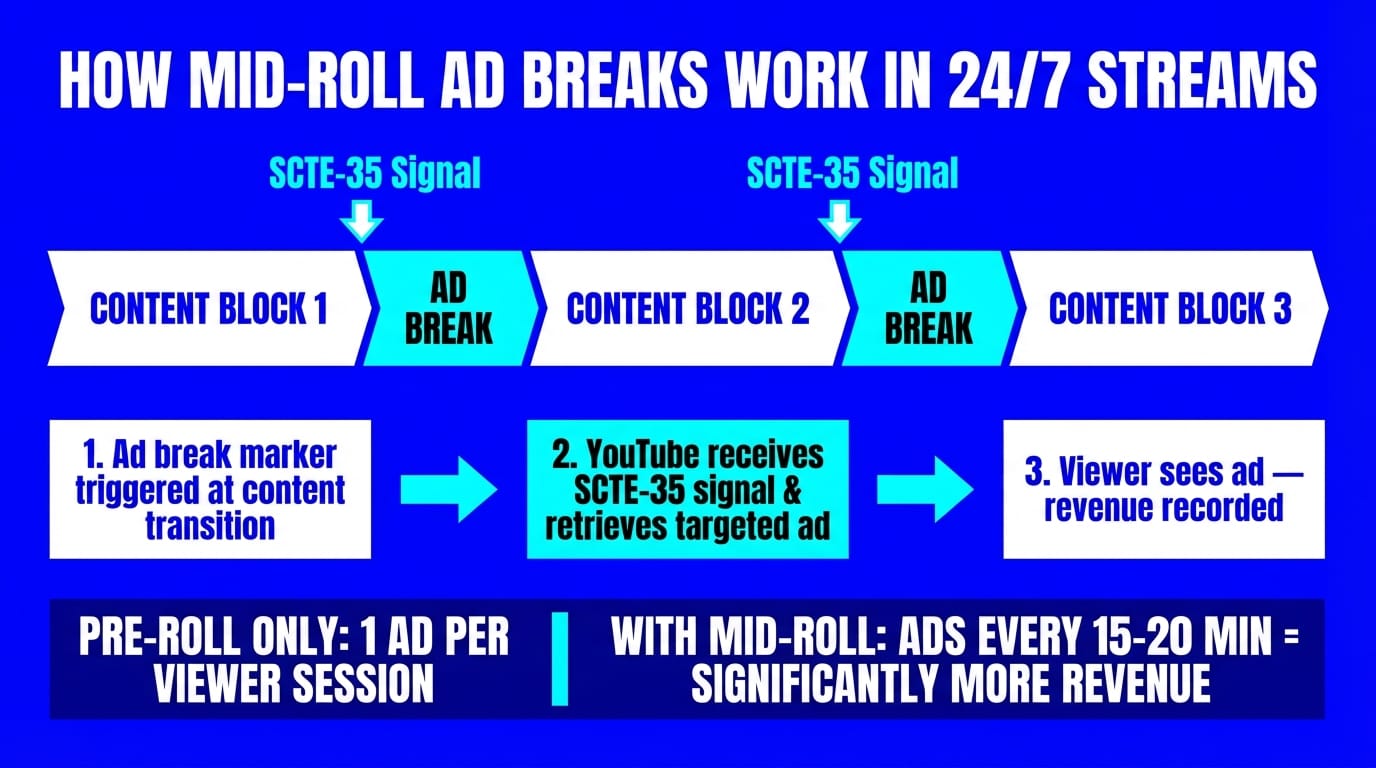
Basic 24/7 streams only serve pre-roll ads (one ad when a viewer joins). This leaves money on the table.
YouTube allows creators to insert mid-roll ad breaks into live streams, either automatically or by triggering them manually during the broadcast. Enterprise streaming platforms and broadcast tools can trigger these ad breaks programmatically — for example, via SCTE-35 signals embedded in the stream, which signal the exact moment a break should start. YouTube then retrieves an ad and displays it to the viewer at that precise point.
What this means in practice:
- You define ad break points in your stream, just like commercial breaks on TV
- YouTube automatically fills those breaks with targeted ads
- Viewers see ads at natural content transitions, not just when they first tune in
- Revenue per viewer increases significantly compared to pre-roll only
SCTE-35 is the broadcast industry standard for signaling ad breaks within a live stream. Triggering SCTE-35-based ad breaks on YouTube requires either a third-party broadcast tool that supports the integration (such as Grabyo or Videon LiveEdge) or an API-enabled streaming platform that exposes this capability. Not all YouTube channels have this enabled by default — it requires account-level activation.
Beyond Ads: Stacked Revenue Streams
Enterprise 24/7 channels typically combine multiple revenue sources:
- YouTube ad revenue (pre-roll + mid-roll via programmed ad breaks)
- Channel memberships and Super Chat during live programming
- Sponsorship placements within the stream schedule
- Cross-promotion driving traffic to paid products or courses
- Custom ad slots for self-promotion between content blocks
Real-World Examples
Music and Ambient Channels
Lofi Girl (~15 million subscribers) demonstrated the model. Their 24/7 streams attract 40,000+ concurrent viewers on average, with peaks exceeding 100,000 during university exam seasons. Continuous streaming builds audience habits and generates consistent ad impressions.
Content Library Channels
Channels with large back catalogs of tutorials, documentaries, or educational content are the best fit. A channel with 500+ videos can program weeks of non-repeating content, creating a genuine TV experience.
Enterprise Brand Channels
Booking.com used LiveReacting to run a "Live Deals" series on Facebook, generating 3.5x their normal page engagement. The same model applies to YouTube: brands broadcast rotating promotional content, product showcases, and curated entertainment 24/7.
News and Information
News channels rotate pre-recorded segments with live updates. The always-on format matches viewer expectations for news, and the continuous feed keeps audiences through multiple segments.
How to Set Up an Enterprise 24/7 Channel
Step 1: Organize Your Content Library
Sort your existing videos into themed blocks:
- Time-based scheduling (morning content, afternoon, evening)
- Topic-based blocks (tutorials, interviews, product demos, entertainment)
- Seasonal rotations (update blocks monthly to keep content fresh)
Step 2: Choose Your Streaming Infrastructure
For enterprise 24/7 channels, you need cloud-based streaming that handles:
- Unlimited duration broadcasts
- Playlist management with automatic rotation
- Programmatic ad break insertion
- Multi-destination streaming (YouTube, Twitch, Facebook simultaneously)
- No local hardware requirements
Step 3: Configure Ad Breaks
Place ad break markers at natural transition points between content blocks. Standard practice: one ad break every 15-20 minutes, matching traditional TV commercial patterns.
Step 4: Launch and Monitor
Start the stream. Monitor viewer retention patterns and adjust programming based on when audiences tune in and drop off. Most cloud platforms provide analytics dashboards for this.
For a complete walkthrough, see the guide on how to create a 24/7 YouTube live channel.
LiveReacting for Enterprise 24/7 YouTube Channels
LiveReacting handles the full stack for enterprise 24/7 broadcasting.
Simple to start: Upload your videos, arrange them in a playlist, hit go. Your stream runs from LiveReacting's cloud servers. No OBS, no VPS, no local hardware. Set it and forget it.
Enterprise when you need it:
- HLS and RTMP streaming with ad slot support for YouTube mid-roll ad breaks. LiveReacting's ad slot feature gives you frame-accurate ad break placement, so ads fire exactly between content segments, increasing revenue per viewer compared to basic pre-roll ads.
- Precise ad slot control and YouTube SSAI. You decide exactly where ad breaks go. Place breaks at natural transitions between content blocks so ads never cut off important information. Also, LiveReacting supports YouTube server side ads insertion (SCTE-35 ad markers) for HLS and SRT streams. That opens even more possibilities for higher ad revenue because the advertisement is stitched inside the video feed, so ad blockers can not hide it or remove it.
- Full API access for programmatic stream control. Start, stop, swap content, trigger scene changes, and manage playlists without touching the dashboard.
- Spreadsheet-based content management. Upload your content schedule as a spreadsheet to program days or weeks in advance. No manual drag-and-drop for hundreds of videos.
- Reliable cloud infrastructure. LiveReacting's servers handle encoding and broadcasting. Your stream runs 24/7 without local hardware. If a video finishes, the next one starts automatically. If your internet drops, the stream keeps going.
- Multi-destination streaming to YouTube, Twitch, Facebook, and any RTMP destination simultaneously.
- Interactive overlays including trivia, polls, and giveaways that boost engagement during live blocks.
- AI host that can introduce segments, announce programming, and interact with chat autonomously.
Brands like Booking.com, NIVEA, McDonald's, and IMAX use LiveReacting for large-scale interactive broadcasts. The same cloud infrastructure powers enterprise 24/7 channels.
Pricing starts at $39.99/month for the 24/7 streaming plan. Enterprise plans with API access and dedicated account management are available for channels needing advanced monetization features.
FAQ
Can you run ads on a 24/7 YouTube live stream?
Yes. Basic 24/7 streams show pre-roll ads when viewers join. You can also trigger mid-roll ad breaks at programmed points throughout the stream, similar to TV commercial breaks. Enterprise streaming platforms allow you to place these breaks at natural content transitions, which significantly increases revenue per viewer.
How much can a 24/7 YouTube channel earn?
It depends on concurrent viewers and CPM. A channel with 500 concurrent viewers in a high-CPM niche (finance, tech, education) can earn $1,000-$2,500/month from ads alone. Channels with 5,000+ viewers and mid-roll ads enabled can exceed $35,000/month.
Do I need new content for a 24/7 stream?
No. The entire model is built on repurposing existing content. Channels with large video libraries can create weeks of non-repeating programming by organizing content into themed playlists and scheduled blocks.
What is a FAST channel and how does it relate to YouTube?
FAST (Free Ad-Supported Streaming TV) channels are always-on, ad-supported streams, like traditional cable channels delivered over the internet. Platforms like Pluto TV and Tubi popularized the format. YouTube is moving in this direction, and enterprise creators can build their own FAST-style channels using 24/7 streaming tools today.
Does YouTube's algorithm favor 24/7 live streams?
Yes. Live streams get priority placement with a "LIVE" badge in search and recommendations. 24/7 streams continuously accumulate watch hours, which YouTube's algorithm rewards with better rankings and more impressions. The key is keeping content curated and varied — YouTube's inauthentic content policy targets mass-produced, template-based operations, not legitimate programmed channels.
Start Your 24/7 Channel Today
The linear TV model works. Enterprise creators with existing content libraries are turning 24/7 YouTube channels into significant revenue streams, without producing anything new.
LiveReacting's 24/7 streaming platform handles everything from simple video looping to enterprise-level HLS/RTMP streaming with programmatic ad breaks. Upload your content, build your schedule, and start earning.
Related guides:
Transform Your Live Streams with LiveReacting
Join 10,000+ streamers who are boosting engagement and viewership by adding pre-recorded videos, games, polls, and countdowns to their streams.
Try LiveReacting for free today and take your streams to the next level!