
Live Commerce: How Brands Are Selling Products Through Live Streams in 2026
Live commerce converts at up to 10x traditional e-commerce. Learn how platforms like YouTube Shopping and TikTok Shop work, plus stats and strategies.
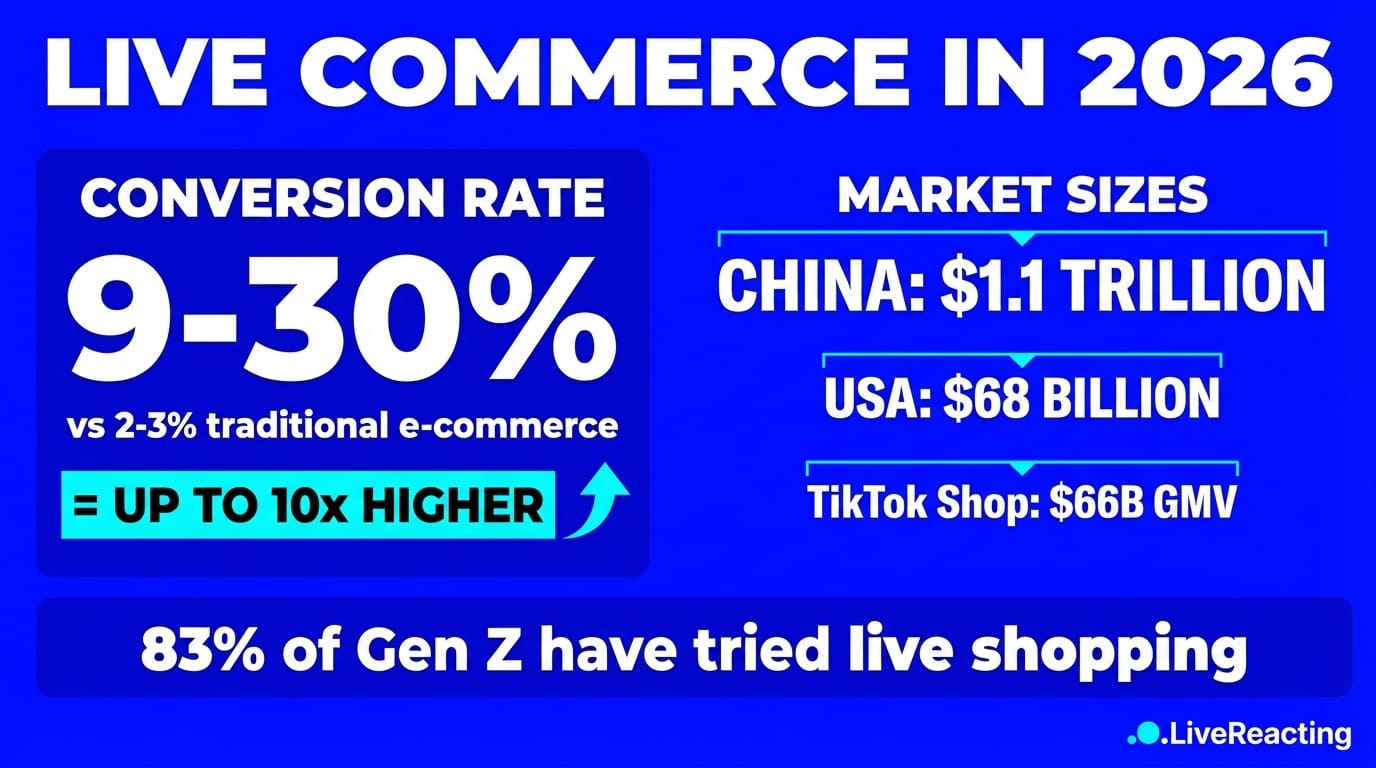
Live commerce is live video combined with real-time purchasing. A host demonstrates products on a live stream, viewers ask questions in chat, and buy without leaving the stream. It converts at 9-30%, compared to 2-3% for traditional e-commerce. That's up to a 10x difference.
China's live commerce market crossed $1 trillion in 2025. The US market is projected to hit $68 billion in 2026. YouTube is rolling out in-app checkout. TikTok Shop doubled to $66 billion in GMV. Whatnot reached an $11.5 billion valuation.
Here's how live stream shopping works across every major platform, what makes live selling effective, and how to get started.
What Makes Live Commerce Different
Think of it as QVC for the internet generation, except the "host" can be anyone: a brand, an influencer, a small business owner, or an AI avatar.
Four things separate it from regular e-commerce:
- Real-time interaction. Viewers ask questions, get answers immediately, and see the product in action before buying
- Urgency. Limited-time offers, flash sales, and countdown timers drive impulse purchases
- Trust. Live demos feel more authentic than product photos. 71% of consumers trust live stream host recommendations more than online reviews (Firework, 2025)
- Engagement. Viewers stay 2.5x longer when content is live and shoppable
Live Commerce in 2026 — conversion rates up to 10x traditional e-commerce
Live Commerce Statistics (2024–2026)
| Metric | Value | Source |
|---|---|---|
| Global live commerce (China) | $1.1 trillion projected (2026) | Statista |
| US live shopping market | $68 billion projected (2026) | Shopify / eMarketer |
| Live commerce conversion rate | 9-30% | McKinsey |
| Traditional e-commerce conversion | 2-3% | Industry average |
| Gen Z live shopping adoption | 83% have used it | BigCommerce |
| Whatnot live GMV | $8 billion (2025) | Whatnot Report |
| TikTok Shop GMV | $66 billion (2025) | Resourcera |
| YouTube Shopping GMV growth | 5x year-over-year | YouTube Official |
| Add-to-cart rate during live events | ~34% | Industry data |
| Live commerce share of all e-commerce | 10-20% by 2026 | G2 |
Live Stream Shopping Platforms Compared
Here's how the major platforms stack up for live selling in 2026:
| Platform | In-App Checkout | Product Tagging | Commission / Fees | Best For |
|---|---|---|---|---|
| YouTube Shopping | Rolling out 2026 | AI-powered auto-tagging + manual pins | Revenue share (varies) | Creators with existing audiences |
| TikTok Shop | Yes | Pin products during live | 2-8% commission + payment fees | Gen Z / millennial audiences |
| Amazon Live | Yes (one-click) | Product page integration | Standard Amazon seller fees | Brands already on Amazon |
| Whatnot | Yes | Auction-style listings | ~10% seller fee | Collectors, niche products |
| eBay Live | Yes (eBay checkout) | Real-time bidding integration | Standard eBay fees | Collectibles, trading cards |
| Facebook Live | No (shut down Oct 2022) | No (removed) | N/A | Not viable for live commerce |
YouTube Shopping Live
YouTube is the biggest opportunity for live commerce in 2026. 500,000+ creators are enrolled in YouTube Shopping, and GMV grew 5x year-over-year.
Key features:
- In-app checkout (rolling out in 2026): viewers buy without leaving YouTube. Previously, YouTube sent buyers to external sites, adding friction. In-app checkout keeps the entire purchase funnel inside YouTube, which should significantly increase conversion rates for live sellers.
- AI-powered product tagging: YouTube automatically identifies products mentioned in voiceovers and shown in visuals, then links them to product listings. Sellers don't need to manually tag every item.
- Shopify integration: sync your product catalog directly
- Product pins during live streams: tag products that viewers can click to purchase
- Shopping analytics: track which products get the most clicks and conversions in YouTube Studio
YouTube Shopping works best for creators and brands with existing YouTube audiences. The platform's discovery algorithm can surface live shopping streams to new viewers based on content relevance.
TikTok Shop and Live Selling
TikTok Shop is the fastest-growing live commerce platform in the US. $66 billion in global GMV in 2025 (doubled from $33.2 billion in 2024).
53.2 million US buyers. 15 million merchants worldwide.
Three shopping formats:
- Live shopping: pin products during a live stream, viewers tap to buy
- Shoppable videos: in-feed product links on regular TikTok videos
- Product showcase: in-app storefront
Fastest-growing categories: Beauty, Electronics, Jewelry, Fashion. US sales grew 407% in 2024 and another 108% in 2025.
TikTok Shop works best for brands targeting younger demographics (Gen Z and millennials). The algorithm rewards high-engagement content, and live shopping streams with active chat get promoted. Knowing the best time to go live on TikTok matters here.
Amazon Live
Amazon Live combines live streaming with one-click purchasing inside the world's largest marketplace. Streams appear on product pages, the Amazon Live page, and in search results.
Key advantage: viewers are already in a buying mindset. Conversion rates are 3-10x higher than standard product page visitors.
Best for brands already selling on Amazon. Influencer-led product streams are gaining traction. The platform handles payments, shipping, and returns. You can also stream a countdown on Amazon Live to build anticipation before product launches.
Whatnot (The Rising Star)
Whatnot is the live commerce platform most people haven't heard of yet. $8 billion in live GMV in 2025 (doubled year-over-year). $11.5 billion valuation.
It holds ~60% market share in North American and European live shopping.
Users spend 80-95 minutes per day on the platform. 80%+ monthly retention rate. 53% of sellers generate the majority of their annual sales through Whatnot.
Features: auction-style bidding, "Spin the Wheel" gamification, $1-start auctions, curated drops. Fastest-growing categories: Beauty (+791%), Electronics (+444%), Jewelry (+259%).
Best for collectors, niche products, and sellers who thrive in auction-style environments.
eBay Live
eBay launched live shopping in the US (2024), UK (Feb 2025), and is expanding to Germany and Canada in 2026. Categories include collectibles, trading cards, sneakers, watches, and fashion.
Features real-time bidding, gamification elements, and celebrity guest appearances. Still early but building on eBay's existing buyer base and payment infrastructure.
What Happened to Facebook Live Shopping?
Meta shut down live shopping on Facebook (October 2022) and Instagram (March 2023). Their stated reason: "consumer viewing behaviors shifting to short-form video."
You can still go live on Facebook, but you cannot create product playlists or tag products in live feeds. Many competitor articles still list Facebook Live Shopping as active. It's not.
Alternatives for Facebook sellers: product tags in Reels, payment-in-chat for direct sales, or linking to external product pages during a live stream.
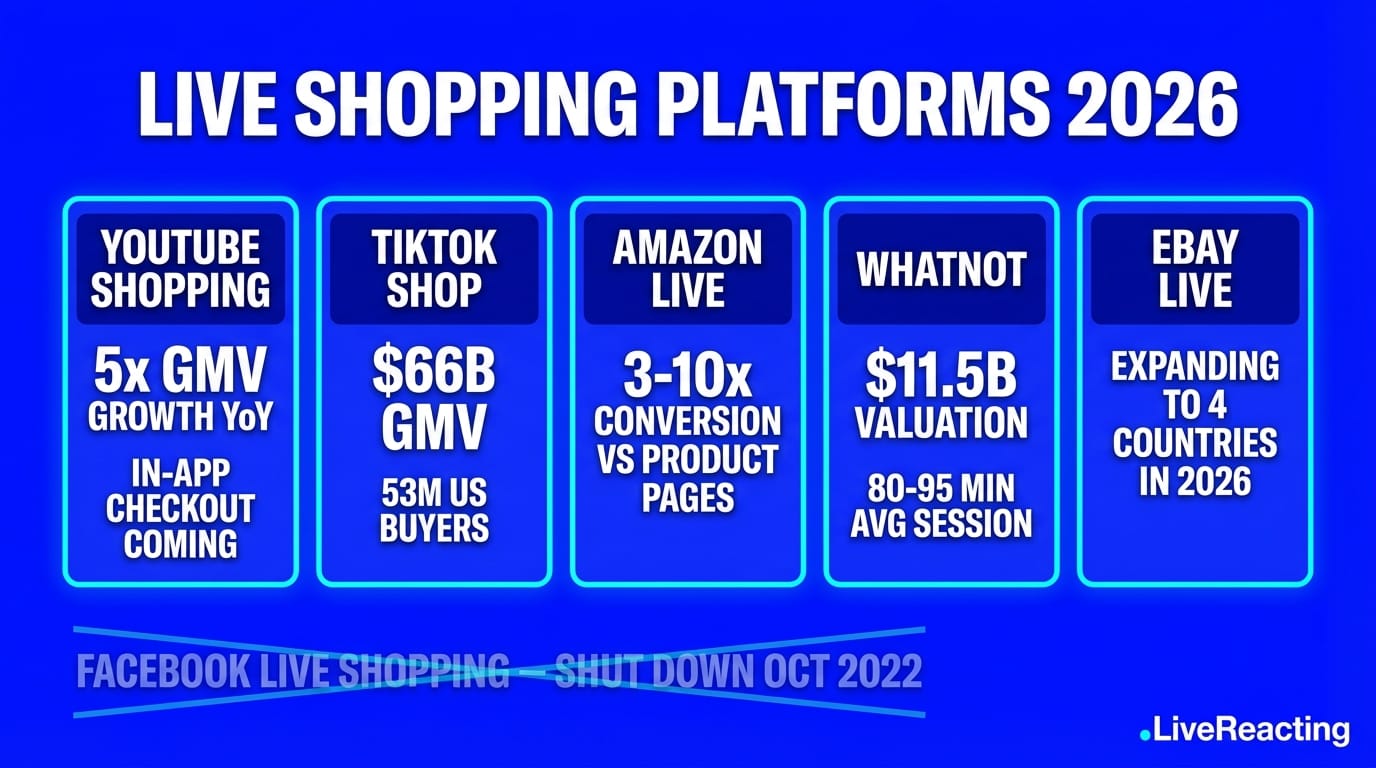
Live Shopping Platforms 2026 — YouTube, TikTok Shop, Amazon Live, Whatnot, eBay Live compared
How Interactive Elements Boost Live Selling
Most live commerce guides tell you to "be engaging" without explaining how. Here are specific interactive features that increase conversion, with examples of how sellers use them.
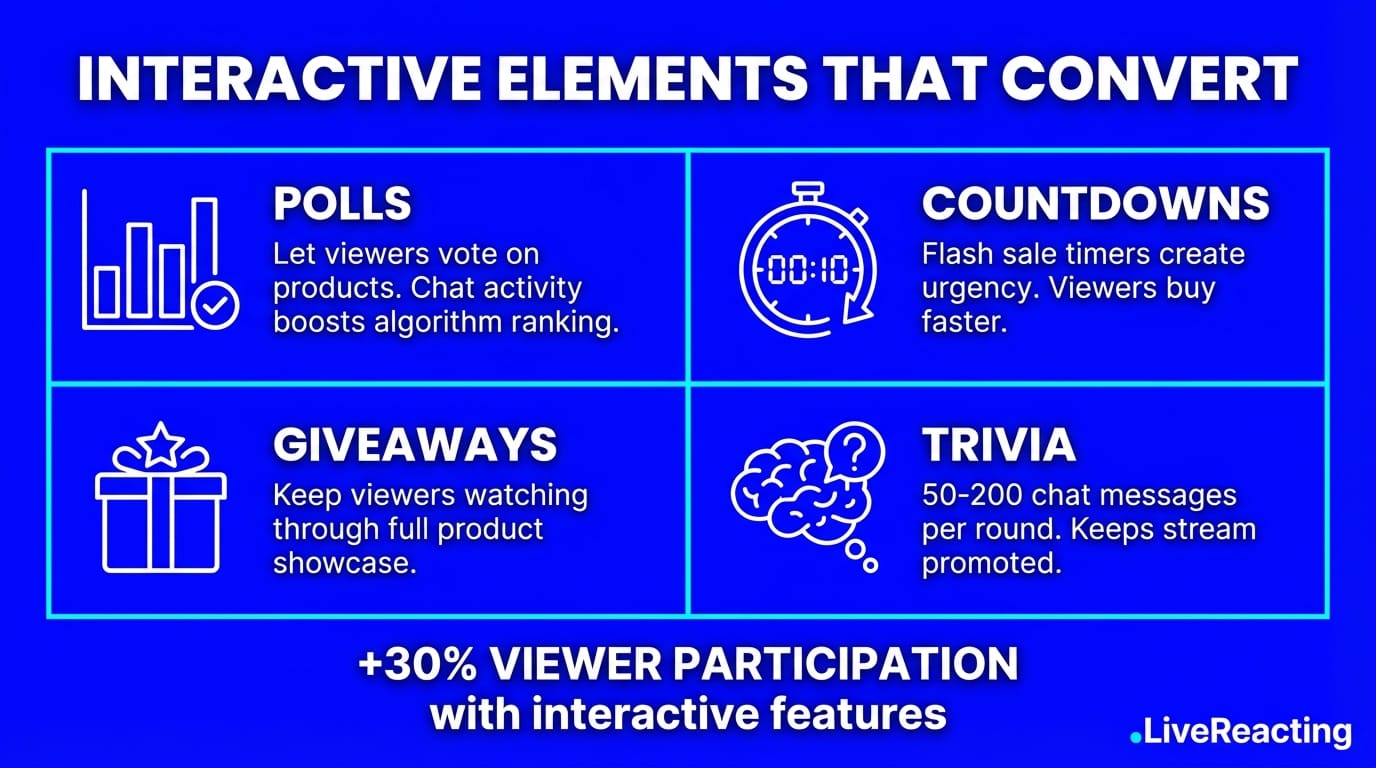
Polls for product preference. "Which color should we release next?" or "Vote for tomorrow's flash sale item." Viewers type their vote in chat, and real-time results display on screen. The vote results update live as comments come in. This does two things: viewers feel ownership over the product decision, and the chat activity signals to the algorithm that your stream is worth promoting.
Countdown timers for flash sales. Overlay a visible countdown timer on screen. "This price expires in 3 minutes." Viewers who are on the fence make faster decisions when they see a timer ticking down. Pair the countdown with a product pin so viewers can buy with one tap before time runs out.
Giveaways for watch time. "Stay until the end of the stream for a chance to win [product]." Viewers type a keyword in chat to enter. A giveaway tool auto-collects entries from comments and randomly draws a winner on screen. This keeps viewers watching through your full product showcase instead of dropping off after the first item.
Here's a real example — a knitting seller running a giveaway during her live shopping stream to keep viewers engaged while showcasing yarn products:
Trivia between product segments. Run a quick trivia game between product demos to keep energy high. A single trivia round generates 50-200 chat messages, keeping the algorithm promoting your stream during transitions. Product-themed trivia ("What ingredient makes this moisturizer different?") doubles as education about what you're selling.
Comment display for social proof. Show buyer comments on screen: "Just ordered!" or "Love this color!" When other viewers see real people buying, it reduces hesitation.
Tools like LiveReacting add these interactive overlays to any live stream, either as standalone broadcasts or as browser source overlays in OBS.
Real Examples: Interactive Live Selling in Action
These aren't hypothetical. Here are real sellers using interactive elements during live shopping streams:
Hobbii (yarn and knitting supplies) ran trivia and closest-guess games during their live shopping streams on Facebook. The result: 8,100 views and 21,000 comments in one hour — a 5x increase compared to their standard live streams. Viewers stayed to play the games and bought yarn while they were there.
Your browser does not support video playback.
Mary Kay Mexico combined a product showcase with a trivia game. 35,000 views and 6,300 comments in just 20 minutes — 2x their typical engagement. Product-themed questions kept viewers paying attention to ingredient details they'd otherwise skip.
Amazon India used a countdown timer for their Weekend Refresh Sale on Facebook Live. 106,000 views, 6,200 likes. The countdown created urgency that a regular product listing can't match — viewers watched the timer tick down and made purchase decisions before it hit zero.
More examples at LiveReacting success stories.
Interactive elements that convert — Polls, Countdowns, Giveaways, Trivia
The Pre-Recorded Advantage for Live Commerce
Most sellers assume live commerce requires being on camera the entire time. It doesn't.
Film a polished product demo showing the item from every angle, demonstrating how it works, and highlighting key features. Then stream it as a live video. Viewers see what looks like a live broadcast. Meanwhile, you're in chat answering questions, responding to comments, and driving purchases.
Why this works for live selling:
- Consistent quality. No fumbling with products, bad lighting, or awkward silences. Every demo looks professional.
- Reusable. Run the same product demo on a loop across multiple time slots to catch different audiences.
- Layer interactive elements on top. Add polls, countdowns, and giveaways over the pre-recorded video. The video handles the product showcase while interactive overlays handle engagement and conversion.
- Multistream the same demo. Broadcast to YouTube, Facebook, and TikTok simultaneously with one setup.
This approach is especially useful for sellers with physical products who want to reach multiple platforms without running separate live sessions on each one.
Live Commerce Best Practices
When to Go Live
- Weekday evenings (7-9 PM local time) get the highest live shopping viewership across most platforms
- Lunchtime slots (12-1 PM) work for quick flash sales and product drops
- Weekend mornings perform well for hobby and collector categories (Whatnot, eBay Live)
- Stream during your audience's peak hours, not yours. Check your platform analytics for when your followers are most active.
How Often to Stream
Weekly beats monthly. Douglas (the German beauty retailer) built a loyal audience by streaming on the same day each week, and their repeat viewers converted at 40%.
Start with one stream per week. Once you have a rhythm, test adding a second weekly slot on a different day.
What to Sell Live
Products that benefit from live demonstration outperform everything else:
- Beauty and skincare: texture, application, before/after results
- Fashion: fit, fabric, styling combinations
- Electronics: unboxing, feature walkthroughs, comparisons
- Collectibles: authenticity verification, condition close-ups
- Home goods: size context, assembly demos, in-room staging
Avoid selling products that look identical to their product photos. Live works when seeing the product in action changes the buyer's perception.
Who Should Host
The best live sellers share three traits: product knowledge, comfort on camera, and ability to read chat. That said, you don't need a professional host to start:
- Founders and product designers bring authenticity and deep product knowledge
- Customer-facing staff understand common objections and questions
- Influencers in your niche bring their own audience
- Nobody works too. Pre-recorded demos with chat-based engagement work for sellers who prefer to stay off camera.
Success Stories
Estee Lauder on Tmall (Singles' Day): 500 million views, $28 million in sales through KOL partnerships during a single shopping event. They ran 12 hours of continuous live coverage with rotating hosts.
Douglas (German beauty retailer): Up to 40% conversion rate from regular livestream shopping shows. Their strategy: weekly schedule on the same day, same time. Repeat viewers who came back each week had significantly higher average order values than first-time live shoppers.
Whatnot sellers: 200% increase in sellers earning $1M+ annually. The platform's auction format and gamification elements keep viewers engaged for 80-95 minutes per session. Top sellers run 4-5 live sessions per week.
YouTube Shopping creators: 5x growth in GMV year-over-year across 500,000+ enrolled creators. AI product tagging reduced friction between product mention and purchase. Creators who added product pins to every live stream saw 3x more clicks than those who only linked in descriptions.
FAQ
Is live commerce only for big brands?
No. Small businesses and individual sellers are thriving on platforms like TikTok Shop (475,000 US merchants) and Whatnot. The key is starting with one product and one platform, not a massive production budget.
Which platform has the highest conversion rate for live selling?
Amazon Live (3-10x standard product pages) because viewers are already in a buying mindset. For pure live commerce, Whatnot reports the highest engagement (80-95 min/day average session). YouTube Shopping is growing fastest (5x GMV year-over-year).
Can I sell on Facebook Live in 2026?
You can go live on Facebook, but the dedicated Live Shopping feature was shut down in October 2022. You cannot tag products or create product playlists in live feeds. Alternatives: link to products in the description, use payment-in-chat, or direct viewers to your website.
Do I need to be on camera?
Not necessarily. You can stream pre-recorded product demos as live and interact via chat, or use AI avatars. The key is having a real-time interaction layer, not necessarily a live camera.
How much does it cost to start live selling?
Most platforms are free to start. TikTok Shop, YouTube Shopping, and Amazon Live don't charge upfront fees. They take a commission on sales (typically 2-10% depending on the platform and category). Your main costs are products to demonstrate and basic streaming equipment (a smartphone and good lighting is enough to start).
What's the difference between live commerce and live streaming?
Live streaming is broadcasting live video to an audience. Live commerce adds a purchase layer on top: product tags, in-stream checkout, shoppable links. Regular live streams entertain. Live commerce streams entertain AND sell.
When will YouTube's in-app checkout be fully available?
YouTube is rolling out in-app checkout throughout 2026. It started with select creators and Shopify-connected stores. The feature lets viewers complete a purchase without leaving YouTube, which removes the biggest friction point in YouTube live shopping today (being redirected to an external site).
What products sell best on live streams?
Beauty, fashion, electronics, jewelry, and home goods consistently perform best. Products that benefit from live demonstration (showing texture, fit, size, or how they work) outperform products that don't need visual explanation.
The Bottom Line
Live commerce is projected to account for 10-20% of all e-commerce by 2026. Conversion rates are 10x higher than traditional product pages. The platforms are investing heavily: YouTube's in-app checkout, TikTok Shop's expansion, and Whatnot's $11.5B valuation all point to live stream shopping becoming a standard sales channel.
The sellers who win combine product demos with interactive engagement. A live stream with polls, countdowns, and giveaways outperforms a passive product showcase every time.
Start with one product, one platform, and one interactive element. Scale from there.
Transform Your Live Streams with LiveReacting
Join 10,000+ streamers who are boosting engagement and viewership by adding pre-recorded videos, games, polls, and countdowns to their streams.
Try LiveReacting for free today and take your streams to the next level!